Friday, 11 May 2018

Day 48 - Mongolia Tour. Return From Eight Lakes

Day 10 on tour. 

All of a sudden an alarm could be heard & it was 8am. After the usual morning requirements, We had some free time which we spent enjoying the sunshine & taking even more photographs!

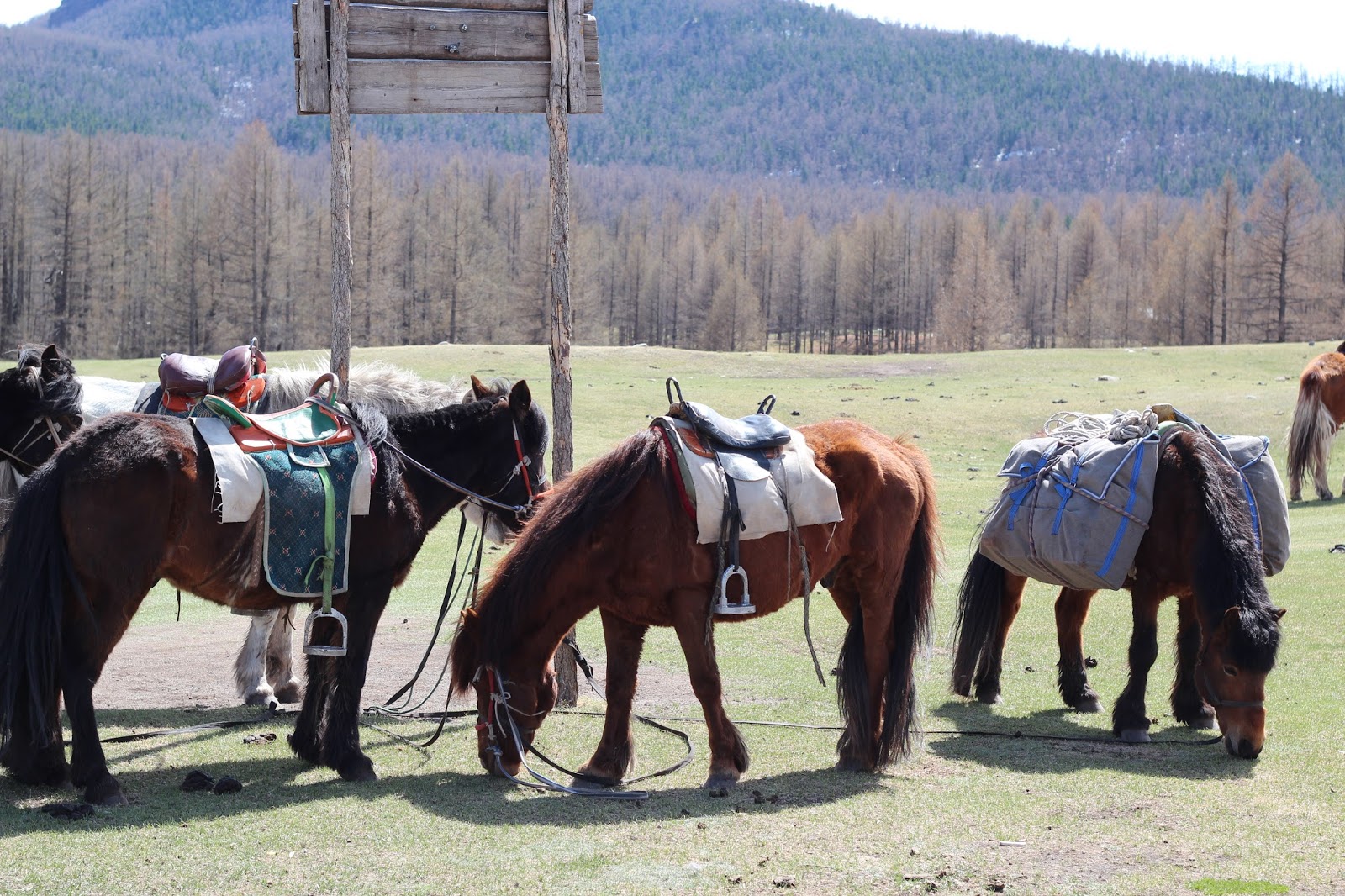
It was around 10.30am when we set off on our horses back the way we came, up & down the mountains. It looks so different when it's not covered in snow. We rode for about 4 hours at a fast trot when the terrain permitted. We then stopped for lunch & swapped our horses for the tour van & our driver Jackie. Bakky the horse guide would meet us at his guest house later, as we drove off we could see all the horses galloping across the grass.

On our way into the national park a few days ago we were meant to stop at a waterfall but weren't able to see due the heavy snow fall. We were now on our way to see it, in all its prime from the melted snow. We spent about an hour here before heading back to Bakky's guest house where he had already arrived with all the horses.
It was good to be reunited with more of our belongings. This was promptly followed by a face washer shower & dressing in some fresh clothes that do not smell like horse!

When I heard the adult goats & sheep return to feed their young, I ventured outside for some goat love & a game of hide & seek with the children.

Even with a language barrier, Mongolian children are very happy to play with foreigners & show off their toys & favourite pets.

- Alli


Day 47 - Mongolia Tour. Eight Lakes

Day 9 On Tour.

When I first started to wake up, it was to the noises of the Yak, snorting to each other. The next thing I felt was my face! Despite applying moisturizer 4 times, it was an angry, dry mess. I have a section on my chin that is pretty severe & covered in tiny blisters. Thankfully I manage to procure some small sachets of emergency sunscreen for the next 2 days.
Outside more snow had melted, but we could still see it sitting heavy on the mountains, in river beds & gripping on to the trees.

Before long we had saddled up the horses & set off for another big day of riding. Thankfully the snow had started to melt, todays riding took us up & down the sides of mountains, weaving between trees, fallen logs & rocks. Despite a more challenging trail for the horses & for us, it was breath takingly beautiful & peaceful. The air was so fresh & cool, the smell of pine trees strong & the sound of our horse guide singing in Mongolian.
We reached our next guest house at 3pm & stopped for lunch. We covered about 10 km's going up & down the mountains to a section in the national park called Eight lakes, totally secluded & can only be reached by horse or foot.
The family we stayed with had a large herd of goats, a few horses, some sheep & an orphaned lamb that the 2 children were carrying around & playing with.
After lunch & a quick nap, we gingerly got back in the saddles & set off to explore the lakes. We rode through more breath taking landscape. Imagine pine trees with icicles, glistening frozen lakes, animals grazing constantly on green never ending fields, rolling hills, rock formations & gullies all under a vast blue sky full of birds of prey swooping around. Mongolia is truly one of the most breath taking & peaceful places we have ever been to. I keep writing it, I can't honestly write it enough! The videos & photos are beautiful, but tragically fail to capture what it feels like to experience Mongolia like this on a horse.
After about 9 km's of riding at a brisk trot we reach the last & biggest lake. We let our horses off to feed & climb the small mountain next to the lake, at the top a worthwhile view & a few great team photo opportunities. After 2 days of riding, climbing up the mountain was no easy challenge.
When we arrived back at the bottom, the sun had just set, making it around 8pm. The horses were in great spirits realising we were on our way home. The track home was slightly shorter and a lot flatter, we were able to move through some areas at a canter & the rest at a fast trot. On one particular flat section, my horse was feeling a bit too frisky & tried to kick the other horses multiple times. I was so grumpy with him after that & had to ride him away from the others. We arrived back at our ger around 9.30pm, it was freezing cold again & I could hear the horses hooves snapping the frost covered grass. Dinner felt like the most delicious meal I had ever had (Mongolian stew) and I realised I was ravenous from such a big day. My second bowl of soup was barely finished before my eyes were trying to shut by themselves.

Today has been a huge highlight for us, something we will always remember & cherish.

- Alli


Day 46 - Mongolia Tour. Eight Lakes

Day 8 on tour.

It was very cold overnight & the fire needed to be restarted a few times. Despite not a great sleep, it was a fairly early start, not that we minded. It was our first day of horse trekking! Something we have been avidly waiting for.
The snow continued to fall overnight, covering the gers, animals & land in at least a foot of fresh powder. Thankfully the wind had died down & the sun was shining. The view was amazing!
After breakfast I helped Bakky's wife feed all the kids (baby goats) then catch them & put them in a spare ger to protect them from the cold weather.
It's very rewarding work, living nomadic. We both love the hands on approach & the rewarding sight of the satisfied goats wagging their tails & playing in the snow.
After the morning work was done & we had all of our stuff packed, it was time to meet our horses. It's also worth mentioning we have to pack extremely light, apart from clean jocks & knickers, our only clothes are the ones we will wear. No clean clothes for 3 days!

Fearing the weather I wore 2 pairs of socks, 2 pairs of legging thermals, tracksuit pants, thermal singlet, T- shirt, long sleeve shirt, jumper, scarf, beanie, gloves & jacket. Tom & I shared a back pack for our sleeping bags, camera, go-pro, toilet paper, baby wipes & extremely minimal toiletries. We had a small disagreement about the necessity of sunscreen, which was left behind. We were then dressed in traditional Mongolian Dells  which are the giant wool insulated coats designed for horse back riding in extreme cold weather.

We were warned about the half wild nature of Mongolian horses, especially in spring. The horses aren't used in winter & were still a little bit weak & skinnier than preferred. However they proved to be very tough & strong enough for our trip.
Tom was first to meet his horse, a handsome old grey gelding. Tom would later call him Gandalf The Grey. He was a sturdy, well mannered slow horse who loves eating & sleeping & dislikes moving fast unless he absolutely has to.
Jordan was initially paired up with the a young brown gelding, who was very stubborn, lazy & determined not to go very far. He made this obvious by continually lying down & needed to be smacked to get back up. Jordan would later swap another 2 times before riding & liking the youngest bay horse that would cooperate & listen to him. He was nicknamed toasty.

I was paired with a dark brown gelding who was a little bit naughty & is a dominant member of the herd, has a bad habit of biting & kicking the other horses. We bonded really well though & I thoroughly enjoyed my time with him.
Undra our guide had a dark brown horse who was also fond of biting, being an experienced horse rider she didn't have any problems controlling him though.

We set off through the snow at a nice easy pace. The sun was bright, the sky was blue & the snow was sparkling. We continued like this for a few hours, winding up & down hills, across rivers & through trees. We kept at a nice slow pace, occasionally the horses would slip on a rock or break through a section of ice. When we stopped for lunch the ground was still covered in heavy snow and it was still very very cold, but we could see the snow starting to melt & the forecast was all sun.

When we stopped at our guest house it was just before 5pm and we had covered approximately 18kms.
By this stage a lot of the ice on the open fields had melted & it was dripping off trees. It was that perfect half green grass & half snow that showed off the beauty of the land.

We went into the families ger & had milk tea, made from their Yaks. It was the first time I had seen a Yak up close, they are quite majestic & playful. This nomadic family has a lot of Yak, as well as hybrid Yak/Cows, sheep, goats, horses, 2 dogs & a ferociously affectionate cat.

We spent the remainder of the sunlight playing with the animals. It was around this time when we started to remove the clothing & sun glasses from our faces & noticed the partial & severe reflective sun burn from the snow & the wind burn. My forehead, eyes & cheeks were protected but my nose & chin were very bad, it was only the freezing temperature that prevented me from feeling it & was probably a factor for the severity.

Sleep that night came very easily & didnt seem long enough when we awoke.

- Alli


Day 45 - Mongolia Tour. Naiman Nurr National Park

Day 7 on Tour.
We were woken at 6.45am by an alarm & were delighted to hear the wind had died down & that we weren't in danger of being pelted with sand anymore.
The plan was to set off by 8am, but when Jackie checked the van he discovered a slow leak in one of the tyres & needed to repair it. Less than an hour later we were off!
It's a big day of driving as we leave the Gobi desert region & head into central Mongolia. An approximate total of 300 km's on bumpy dirt roads. It was around 11am when we started to notice the first shades of green grass covering the hills. As we left the desert further behind the temperature drops but the grass became greener, longer & the herds became larger. It also started to get dramatically colder. Despite the green grass, the herds of livestock looked thinner & we saw a larger number of dead animals. The animals living in the Gobi desert spend hours digging up roots & sparse amounts of grass to eat, proving there is food!
Here the grass looked abundant, plenty for everyone... maybe it's not high in nutrition or the animals expend more energy staying warm ? Whatever the reason, the death toll here is higher & the rolling green hills were tainted with the dead who weren't strong enough to survive winter. We stopped at 1.30pm for lunch in a scenic village & restocked our vodka supplies before continuing on. At 4pm we stopped at the entrance of Naiman Nurr National Park to stretch our legs & photograph Mongolia's Orkhon River.

While admiring the view a few tiny snow flakes fluttered by my face. It was so exciting to see! We kept driving for another 2 hours into the national park & were confronted by a swirling snow storm that progressively got heavier, blanketing the sky in whiteness. When we got to our ger camp there was a solid foot of fresh powder covering the ground. The nomadic family greeted us with hot milk tea, dinner & some home made fermented berry wine. The wine contains 3 types of wild berries picked in the mountains & fermented. The family will drink it all through the winter as a deterrent for the common cold.

The nomadic family is a young, attractive couple, who have 2 young children, a puppy, a modest herd of goats & sheep and a few Mongolian horses. The husband, who'd shortened English name is Bakky, will be our horse guide over the next few days.

Tom & I spend an hour or so running around in the snow with the puppy & the goats. It's so magical to be in the snow, in the national park. I feel like we have been shown another of Mongolias hidden, natural beauties.
Hopefully the snow doesn't get too heavy or turn into rain.
We were told Mongolia is a place you can see the 4 seasons in 1 day, we definitely did today. We awoke in the dry, dusty desert, then crossed kilometers of green hills under the bright sun & blue skies, we are going to sleep in our ger listening to the eerie silence of snow fall.

- Alli


Day 44 - Mongolia Tour. The Ruins Of Ongiin Khiid

Day 6 on tour.

We were told the previous night that we would be starting an hour later than normal & to enjoy a sleep in. I took full advantage of this information and stayed up into the early hours of the morning reading.
Breakfast was at 9am & we left our camp shortly after 10am. The nomadic father of the camp came to see us off & surprised us with some English "thank you & have a safe trip" after we gifted him a block of chocolate. I particularly liked sitting with him & his family in their ger drinking hot milk tea, despite the sweltering heat of the desert. He has a warm welcoming smile & a twinkle in his eyes that portrays a life of happiness he lives & projects.

With only a small journey today, we arrived at our new campsite at approximately 1.30pm.
Again the landscape has changed dramatically. The different colors of dirt & sand combined with various rock's, stones, fauna & flora are never similar for more than a few kilometers. We are now camped near the very border of Southern Gobi & will leave this province & the Gobi desert tomorrow. We are camped next to one of the longest rivers in Mongolia, surrounded by brown sand, small hills & rocky mountains with only horses & cows for company.

We had some lunch in a rather grand, stone building with turrets before guarding ourselves against the wind & setting off to visit a Buddhist temple & temple ruins. Since arriving at camp, a fierce wind has made its presence felt, lifting fine sand high in the sky, obscuring our vision & also punishing any bare skin exposed.
The temple ruins are known as Ongiin Khiid or The Pearl Of The Desert.
Built in 1760, the temple facility, located along the green banks of the river; use to be the heart of Mongolian Buddhism belief, with over 1000 monks, 30 individual temples on the North & South river banks & 4 Buddhist universities.
During the 1930's communism spread through Mongolia. As part of the initial campaign for power, buddhist monks were arrested all over Mongolia. In 1939 the Monastery itself was completely destroyed with approximately 200 Monks killed, the surviving Monks were imprisoned, conscripted to the communist army or fled.
The river was then misdirected to sustain the mines that were controlled by the communist groups. This forced local communities to abandon their villages & it was feared the area would be forsaken & the ruins of the Monastery would be forgotten.
In 1990, the democratisation of Mongolia happened, another huge event in history.
It was at this time 3 Monks, who begun their Buddhist training as children, in Ongiin Khiid, 60 years prior, returned to the site of the ruins. It was their vision & legacy to see the grand monastery restored & to revitalise the buddhism beliefs & education in Mongolia.

Today a small river flows by the monastery ruins, past the tourist camps & the gers of the nomadic families. You can see the walls, the ruins from the many monastery halls & temples stretching over the hills. There is a new temple hall, built by the 3 monks who returned, a place of worship & a museum. There is also a stupor standing proud on the tallest hill, a memorial for the monks who lost their lives. I wish I could turn back time to glimpse what life would have looked like within the monastery as 1000 monks went about their daily rituals & teaching. Even as they are, the integrity of the ruins demands respect, appreciation & wonderment.
Buddhism is still a huge part of Mongolian life, approximately 80% of Mongolians are Buddhist, provinces in Western Mongolia are also Muslim, while an even smaller portion are Christian or have no religion.
Undra, also explained that Mongolian Buddhist belief stems from Tibet & Buddhist monks must read & write prayers in Tibet. In the museum she also showed us the remains of human skulls, cut in half. She spoke of an old Buddhist ceremony that involved the selection of an 18 year old person, normally a girl, who would be sacrificed. Her skull would then be used in rituals to hold spring water. She said a lot of Buddhist rituals are very similar to sharman rituals & can be cruel.

This is very different to everything we learnt about buddhism rituals & belief in China. I'm keen to get back to society & the internet to research further into the buddhism history of both countries.

- Alli


Day 43 - Mongolia Tour. Meat = Murder

Day 5 on tour.

We made camp in a small desert town. The temperature was over 30 deg and the sun was beating down hard with only a slight breeze as a reprieve. We sat in our ger and drank beer to pass the time, also making a trip out to collect some fire wood for the nomadic family hosting us. After some time our driver Jackie came past our ger and explained that our host family would be killing a Camel today to take to market, and asked if we would like to see. As someone who tries to only eat meat as minimully as possible, and when able to prepare food for themselves usually lives vegetarian, I found the idea of witnessing this event as something I needed to do since I still do consume meat. I also feel that in todays society there is a pretty massive disassociation between the act of killing and preparing meat and that of buying and consuming animal products.

I guess I should also mention that I would feel much differently about this experience had it been in an abattoir, in a first world country, in which there is a much more clinical and mechanical process, so far divorced from the basic necessity that i feel here. Also the likelyhood that the meat would end up on someone's plate where it wouldnt be respected as the life that it cost. Wherever you stand on the topic of consuming meat in a first world country. The same rules do not apply in a developing country. You simply could not survive as a vegetarian out here. The only veggies of decent quality have to be grown with spring water, making them very expensive to cultivate. Something many families who live and work this harsh and unforgiving landscape simply cant afford. Its difficult to explain the stark contrast there is out here, compared to what we are all used to at home. Its a completely different world, where our first world privlilage along with our responsibility to consume sustainably are not relevent. There is simply not yet affordable alternatives. To try and apply the moral standards I personally hold my self accountable to at home, would be quite arrogant and ignorant.

To try and explain the profitability of selling this meat. We were told the 400kg of meat would fetch only 2million MNT. About 1,155 AUD. This particular camel took 6 years to reach a point of being considered for sale. So you can see that if you took into account the cost incurred to raise this Camel. However it is still very much a necessity, and a way of life in this country. We were also told that the Camel herders do not like to kill the Camel for their meat, they spend a lot of time caring for them and even the poorest herder will provide his animals with annual vaccinations.. They are worth much more alive and only choose to sell them for their meat if no one will buy the Camel live, this is often the case straight after winter when the animals are skinny. Given all these factors I felt like I would be a hypocrite not to be involved. Otherwise I would have no place consuming the small amount of meat that I do at home when I have access to so many alternatives. 

I dont want to go into to much detail about the process as I don't feel its something I need to describe for people to understand the enormity of the task as well as the moral weight that I felt. I also did not take any photos out of respect for the experience. I do want to talk about the process of killing the Camel, as well as what I took away from the experience.
As a brief overview, the entire process took about 2-3 hours and involved about 8 people. It was extremely heavy work with no tools other than a few knives and a rope. Initially the Camel had been held in a pen near by our ger camp. He had seemed quite calm and relaxed all afternoon. A couple of hours before sunset the family lead the Camel about 100m away from the camp. They then roped his feet and he was brought down onto his side. His head was laid on the ground and one of the family expertly located a gap in the upper vertebrae and severed the spinal column then pushed the knife into the brainstem. Quickly afterward they bled the Camel from a puncture to the throat. The whole process was conducted with extreme proficiency and much care was taken to ensure no undue stress was imposed on the Camel. While the camel lay on the ground everyone fell quiet, and the man who had felt deaths blow gave him stroke on the neck as if to day goodbye. There was a very solemn finality that came over me once the Camel gave its final laboured breathe. I will not forget that moment so long as I live. However the family were moving quickly to prepare the meat and were against the clock to get their harvest to market as fresh as possible.

Despite initially only wanting to spectate, once underway, I was soon offered to assist. All hands were required to conduct the task, and the rest of the family joined to help. As I mentioned I don't think its necessary to go into any more detail from there. It was heavy and gruesome work. Which I'm sure you can imagine or investigate yourself. Definitely a full frontal exposure to Camel anatomy.  In fact if you are a meat eater, I would strongly suggest that it is something you should bare whitness to, and something you should consider very carefully whenever you do consume meat.

After a fairly restless sleep and much moral reflection. I have woken today to write this blog entry as a reflection of my experience. As well as a call to action for people to consider very carefully the sustainability and ethhics of their eating habits. I most definitely will be re-doubling my efforts to marginalize the amount of meat I consume. So as to further a more sustainable and compassionate future. Despite this being a part of the circle of life in this part of the world. I now find myself a very strong advocate of abolishing the wasteful and indifferent nature of our western culture toward animal products, and re-affirmed in me the need for a support, from both camps, of conciencious meat eaters, as that is the transitional step we should all be working toward. I hope that my shared experience will make others strongly question there own perception and morality.

- Tom


Wednesday, 9 May 2018

Day 42 - Mongolia Tour. The Khongoor Sand Dunes

Day 4 on tour.
Today we woke up a lot later & nursing hangovers from the previous night. Our latest night yet (11.30pm) we stayed up playing cards with Jordan & then we were joined by Undra, our tour guide. After we finished with the drinking card games, Undra taught us the Mongolian rules for Uno. All of a sudden the wine, beer & half the vodka were gone. 

Our campsite & gers were set up as more of a tourist camp, which was different from previous nights when we were in spare gers owned by nomadic families called guest houses. Because of this our ger had a newer fire place, better insulation & the fire was made of wood instead of dried dung. The inside of the ger was sweltering hot, we were playing cards in singlets, shorts & thongs, it was a relief to walk the 50 meters to the toilet in the cold. This also meant we slept on top of our sleeping bags & did not get cold the whole night. The next morning the ger was still very warm, we opened up the door to let cold air in as we packed our bags for the day. We left camp at the usual time, around 9am. Were going to miss the beautiful scenery, it's so unexpected to find the mountain ranges & rolling hills looking so green in the middle of the Gobi desert so soon after winter. About 40 minutes after leaving, we drive past a small herd of Yaks ! We also see plenty of gazelle frantically leaping away from the car. 
The landscape changes dramatically & we start to feel like we are in the desert, especially with sand dunes looming in front. We get to our ger camp at 2pm & have a late lunch. Followed by free time, which actually means nap time.

At 4.30pm we leave our ger camp and drive a short distance to meet a nomadic family that own a herd of camels & a very aggressive guard dog that won't let us out of the van. Once the guard dog had been tied up we are paired off with a camel each & told how to get on & position ourselves between the 2 humps. It's very awkward as they stand up. 

We rode our camels for an hour through the desert towards the biggest sand dune along the range. Tom's camel was very cheeky & kept trying to overtake the other camels & turn them around. They looked very majestic with 2 humps & a thick, woolly coat that included a mane. We were also able to get quite close to the gazelles who weren't aware of our presence on the camels backs. 

Once we arrived at the sand dune we were told that we were going to climb it & watch the sun set.The Khongoor Sand Dunes. Taking up a section of 900 square kilometers the pale coloured sand can be seen rising up & swirling across the horizon, in striking comparison to the darker surrounding dirt of the Gobi. The peaks of the dunes stand between 100 & 300 meters high. An impressive & scary sight as we rode towards them on camels, knowing we would climb to the top & watch the sun set. 
Tom & Jordan made it to the top in approximately 45 minutes. It took me an extra half an hour to make it to the top. I was having some extreme difficulty, with each step the sand above and around me would start sliding down the dune, making my efforts feel redundant. The sand was so soft & fine, I tried changing tactics with my hands & feet, but nothing seemed to work. I would give up, feeling exhausted, frustrated, close to tears, sweaty & defeated, only to sit down, catch my breathe admire the beautiful landscape & try again. I realised I wasn't making any progress at all & tried to think of a new plan. Along the side of the dune, partially hidden by a ripple, I could see some clumps of grass. Hoping this would mean more secure sand, I set off at a angle to get to the grass. This action by itself cost me another 20 minutes but my efforts were rewarded! The sand was more secure! I could now hold my position & actually move up the dune without sliding back down. Feeling thoroughly exhausted, I would walk with my hands & feet for 20 steps than have a small break before doing another 20 steps. When I got halfway up the dune using this routine, Tom's cheering was the motivation to get me to the top. The view from the top was amazing & the feeling of achievement is priceless. 
I lied down in the sand next to Tom, with shaking limbs & tears in my eyes. 
We both agreed the dune was one of the hardest physical challenges we have ever done, quite a few times I thought I wouldn't be able to make it.
It felt so good, sitting on top of the world in Tom's arms, watching the sun set over the mountains, dunes, desert flats & even a desert oasis. The Gobi desert holds some diverse, hidden & very beautiful sights, you just have to work hard for them, have a sense of adventure & be willing to forgo a few comforts.

Once we climbed back down from the dune, it was around 8.30pm & we were starving! It was at this point Tom must have given his face a really big rub & induced his allergies! While on the camel, he admitted to being mildly irritated & there was a few sneezes. A few hours later & without the ability to wash our hands between activities, it was a full assault to his nose & eyes. Once we got back to camp, it was a job appropriate for phenergan, a face cloth shower (we didn't have a real shower) and a hot cup of tea. Within the hour he was asleep & snoring.

What a day! Hopefully we're not too sore tomorrow.
-Alli