Wednesday, 4 April 2018

Day 20 - The Big Wild Goose Pagoda

The Big Wild Goose Pagoda,


Our day started surprisingly early, mostly from the construction noises that we could hear even from 7 storeys up! We fuelled ourselves with a breakfast beer before setting off for the day to explore the beautiful city of Xi'an, heading in the direction of the Big Wild Goose Pagoda and the Shaanxi History Museum. We were surprised to feel the difference in temperature, it was a beautiful crisp morning of 10 degrees celsius, in comparison to the previous day when it reached 30 degrees celsius. I'm so excited for cold weather & to finally wear some of the winter clothes I've been lugging around in my pack.

We stopped in at a local restaurant for some food, Tom ordered this pastry meat meal he has had before, a guy at the counter could speak some english and was very amused by my pointing at the menu pictures. After we had ordered and paid, he informed us that there was donkey meat inside the pastry while laughing. Were not sure if he was joking or being serious... lol?

The Big Wild Goose Pagoda, Also known as the Dayan Pagoda, or the Giant Goose Pagoda was built in the great Ci'en temple, South of the city wall of Xi'an. It was built in AD 652 & was built as a place for the monk Xuanzang to translate Buddhist scriptures. Xuanzang travelled for 17 years through 100 countries obtaining Buddhist materials, mostly from India, the cradle of Buddhism. All of which was stored inside the pagoda.

It has undergone many restorations & extensions, initially starting at 5 levels, It was later doubled to 10 before being devastated by an earthquake. The pagoda we see now is 7 levels, 64.5 metres high & appears to be on a slight lean. It was very humbling walking up through the inside of the pagoda, running our fingers along the ancient brick work & inscriptions. It is such an ancient building, still holding amazing Buddhist relics & spiritual belief.
As a place of holy worship, with monks still present in Ci'en temple, we weren't able to take many photos of what we saw. Some things just have to remain as memories!

After climbing the pagoda, we spent a few hours walking through the Ci'en temple admiring the beautiful gardens & watching people light incense and pray to their favoured buddhist statue before heading towards the Museum. 
When we left the Ci'en Temple grounds we were hit with our first dust storm of the trip, only mildly uncomfortable, mostly due to the wind being fiercely cold in comparison to the warm day. Thankfully it didn't last too long.

Once we got to the Shaanxi History Museum there was a moderate line of people waiting to gain entry and an announcement that said the museum had reached its daily capacity and would not be permitting entry to anyone else today. On their website it says they only issue tickets to 6,000 people a day, 3,000 in the morning and another 3,000 in the evening. Maybe we will have another go tomorrow or hold out for a museum in Beijing.

We start to head back in the direction of our hotel, realising for the first time today that our legs are sore, after checking our exercise trackers we realise we have walked 17 kilometres! its very easy to do when exploring a city, its amazing how quickly our fitness is improving, it feels like only last week our legs were protesting at 5 kilometres.

We spent a few hours at the hotel 'refuelling' before heading out to into the city centre to enjoy the night life. Once in the city it's hard to miss the ancient bell tower of Xi'an, geographically marking the centre of Xi'an city.  Built in 1384, it stands 36 metres high & is an impressive sight, especially at night. Located northwest of the centre of town & the bell tower is another ancient tower that dominates the sky & demands attention. The Drum Tower of Xi'an, built in 1380. It used to signal the running of time & an emergency situation, now it houses the biggest drum in China. Amazingly this tower, although built in ancient times with posts, panels & brickwork, doesn't contain a single iron nail. It also has 24 drums on its North & South sides, representing twenty four solar terms, which was an ancient Chinese weather calendar, in order to guide agriculture production. North of the city centre and the Drum Tower is known as the Muslim hub, with over 20,000 Muslims living here & about 10 mosques. Every night they have a night market, THE BEST night market we have been to in China! The market was a hectic blitz of colour, community spirit, smells both good & bad, music, laughter, yelling, bartering, food of all kinds, cheap trinkets, expensive souvenirs, traffic on foot & wheels. We got swept up in it for a good hour or so. We loved every second, being a part of the chaos. All of a sudden it was 10pm, 10 degrees and starting to rain. We successfully caught a bus all the way to our hotel doorstep! With a total of 25 kilometres of exploring done today its been another fantastic day in Xian, a city we both love & would 100% come back to.

-Alli


Tuesday, 3 April 2018

Day 19 - The Terracotta Warriors

The Terracotta Warriors,

Today started at 9am (we are loving our late nights & sleep in's) with a coffee & rebooking one of our train connections that declined overnight.

After rectifying the train ticket issue we caught the 206 bus into the city, we missed our stop by 1 block & had to do some walking. We then located the 306 bus at the central train station to take us 40minutes out of town. The bus ride was comfortable & uneventful.

The Terracotta Warriors were originally discovered by village farmers in March 1974 while drilling a well. The terracotta warriors are life like terracotta statues made as funerary objects for the superstitous Emperor Qin Shi Huang to protect & serve in the underworld. The emperor was 13 when he ascended the throne & ordered the construction of the army, it took approximately 38 years to build & 720,000 people worked on the project. The pits hold approximately 8,000 individual statues featuring complicated & vivid detailing, no two are the same. Emperor Qin's terracotta pits are the largest funerary pits and are located 1.5 kilometres east of emperor Qinshihuangs mausoleum, symbolizing the main defending force that guarded the capital before it's emperor died. Surprisingly these pits are not mentioned anywhere in the historical records until they were found.

We viewed pit three first, the smallest of the pits. Pit three was discovered in June 1976 located north of pit 1 & east of pit two. It is about 520 square metres measuring 28.8 metres long from east to west and is in the shape of a 'U'. Investigation shows that pit three was seriously destroyed sometime in history with only 68 pottery figures one chariot and 34 bronze weapons recovered. We spent about 15 minutes in pit three, admiring the warriors, some of which were missing heads & a section that shows the warriors completely smashed to pieces. Archaeologists speculate the removal of the warriors heads was an act of ancient vandalism. Despite the warriors disfigurement they remain quite splendid in comparison to the warriors in pits 1 & 2. Unfortunately there is evidence of fires in pits 1 & 2 which had incinerated details on the warriors and forever destroying the chariots.

Next was pit two, the second largest of the pits and the only one shaped like an L. This pit was discovered in April 1976 covering in area of 6000 square metres . It measures 124 metres long from east to west, 98 metres wide from north to south and 5 metres deep. Different from pit one and pit three, pit two consists of mixed military forces in 4 categories. There is archers, war chariots, cavalrymen and infantry men. This reflects the unique strategy of Qin military. For me, Pit two was slightly disappointing as the excavations were very minimal and you could only see mounds of dirt. At this point you can only speculate what amazing warriors still lay hidden underneath. In it's own way, it's cool to see an active archaeological site. A meticulous & slow job requiring an abundance of patience, something I would not be suited for despite my love of ancient history. Pit two was also the first place where we saw up close fully excavated & restored warriors. They had a different warrior from each category & a horse, now supported & protected behind glass to be enjoyed by millions.

Lastly was Pit one. The largest pit is a subterranean earth and wood structure. It measures 230 metres long from east to west & 62 metres wide from north to south. There was a lot of intact warriors as well as a lot of warriors that where under restoration process. Because the warriors were made of pottery, when they were uncovered by archaeologists, a lot of the warriors and horses were mixed together within hundreds of pieces of broken pottery. It's a huge, complicated process to carefully extract them from the pits, restore them to as close to their former glory as possible & then put them back into their places. It's assumed that more than 6000 pottery warriors and horses will eventually be recovered from this pit alone.

Some of the statues are bigger than life size and exquisitely made in extreme and vivid detail. This represents advanced technology in chinese sculptural history. The excavation of the terracotta warriors and horses provide extremely valuable data for the research of Chinese ancient politics, military, science and art.

Definitely one of the coolest things we have seen, an archaeologists or historians dream & for obvious reasons proclaimed an 8th wonder of the world! We will never forget this truly amazing pice of history.

After spending a few hours in the pits and museum we were on our way to the exit, trying to avoid the souvenir vendors when we spotted a food court with western food! Something we have been craving. We both rush into the Subway and are delighted to see it is not ridiculously over priced either! A couple of footlong subs later, we climb onto the bus and fall into a food coma. 

Another great day in Xi'an! 

- Alli


Day 18 - Xi'an

Xi'an,

We arrived in Xi'an on Easter Monday at 1am, needless to say we didn't start our first day exploring the city until after lunch!

Xi'an is the capital of the province Shaanxi & by far the cleanest & greenest city we have been to within China. We decided to walk through the city & check out the wall of Xi'an, also known as the fortifications of Xi'an. Standing at 12 metres in height, 12 metres in width & with an outside perimeter of 13.94 kilometres, it is impressive to say the least! On top of this the wall is also considered the oldest & best preserved ancient city military defence system of its kind still in existence!

With little other knowledge than that we wanted to mount the wall we walked along the inside perimeter until we found an entrance to the top. Once at the top we were given spectacular views of the city, there is also a moat that surrounds the outside of the wall. Originally built out of rammed earth this monument was under construction during the 3rd - 11th years of emperor Hongwu's reign (1370 - 1378 AD), since then it has undergone many extensions & renovations which has resulted in the wonder we enjoyed today. During the reign of emperor Longqing it was rebuilt with bricks for the first time, something that has preserved the integrity of the structure. The brickwork is very precise, with attention to detail paramount. It is evident in the individual bricks which contain Chinese engravings. After admiring a section of the wall by foot, we hired some bicycles and rode the rest of the perimeter! Neither of us had been on a bike for years, it was great nostalgic fun & an excellent way to complete the 13.94 kilometre circuit. Tom celebrated with a few tricks and rode a good section of the wall with no hands, much to the delight of the Chinese tourists photographing us.

We spent a few hours on top of the wall riding around, taking photos, watching the world go by & having a few semi-cold beers. The Chinese really don't understand the benefits of a very cold beer vs a warm/semi cold beer. All of a sudden it was evening & time to find dinner. The food in Xi'an is on the whole much cheaper than the other places we have been. As a result we quickly found a street-side cafe that smelt good, pointed at a few pictures on the menu & enjoyed both our meals, we are still unsure exactly what it was we were eating! Noodles with something! But thats all part of the mystery. English is becoming more and more scarce, I think there will be quite a few guess as you go meals when eating out.

As we turned the corner into our hotel complex there was a man selling fruit out of a large basket, I brought a kilo of berries for the price of $3.25 AUD. My fingers, lips & teeth are now a fantastic shade of purple!

Once home and safe at our accommodation we planned out the last 2 weeks of our China holiday & booked 4 lots of train tickets. We had to make some serious decisions about what we really wanted to see & do. One month just isn't long enough, but the world is so big & there is so many other places to see.

All in all - a fantastic first day in Xi'an.

- Alli


Day 17 - Zhangjiajie (Wulinyuan district) - Xi'an

Finally Xi'an & the next part of our adventure. 

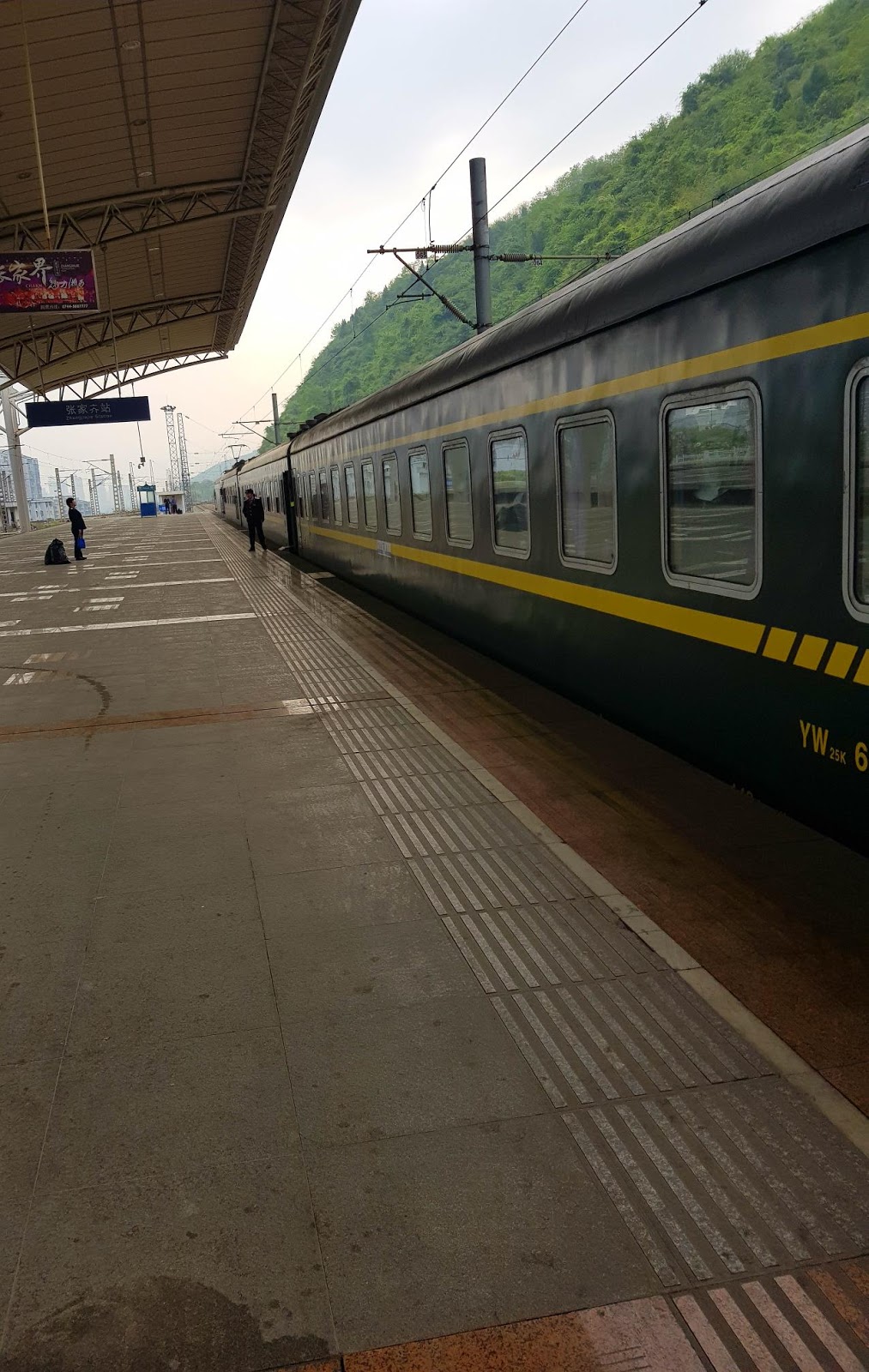
We managed to book our train ticket on the internet with no help! A small success in the scary Chinese internet. We are travelling just over 1000km's south by train into the Shaanxi Province. The journey will take about 15 hours by train & starts at 10.18am.  For this reason we booked hard sleeper tickets, which basically means a bunk bed in a carriage. The soft sleepers are slightly more expensive and nicer, also sold out. Tom & I brought what I'm assuming were some of the last tickets as we were split up! Still in the same train carriage but 17 rows of bunks apart. I wasn't really sure what to expect, but I was happily surprised! My bunk was on the bottom & the sections of bunks were quite spacious, there was some seats & tables, a large window & curtains for privacy. In the first 2 hours, the section I was in seemed empty except for 2 other Chinese gentleman who weren't fazed by us at all. It's nice to be ignored! We've had a lot of attention in China, particularly at Chinese attractions, theres lots of pointing & people taking photos & videos of us. 

Tom spent the first part of the journey sitting with me on my bottom bunk while we read & listened to music. Shortly after midday the 2 gentleman got off and a mother with a teenage daughter & a toddler hopped on. A different ticket inspector came by & I was pointed to move up to the middle bunk despite our English confirmation ticket saying lower bunk & the first inspector pointing at the lower bunk. This meant Tom had to go down to his section. I was later grateful for moving up a bunk cause it turned out the toddler was loud & naughty. At 3.30pm some more people boarded the train, filling up the section of bunks I was in. 1 man was angrily pointing at the middle bunk, that I was now lying in. The first and second ticket inspector came to check tickets and realised they moved me to a bunk that didn't match my ticket redirected the man to the bottom bunk that I started in. Bloody hell what a mess! 

A feature of the Chinese trains is a hot water dispenser, which is handy for making your own tea & big bowls of noodles! We always buy plenty of snacks for these trips & decided to give sliced, dried kiwi fruit a go. Probably won't buy them again! They are really tart & not a nice texture.

Eventually we arrived at about 1am as sheduled & caught a taxi to our hotel. After the standard amount of difficulty locating the reception, mostly due to a massive construction site on the street, we checked into a different room than advertised, a large room with 2 double beds. Although this was an upgrade we didn't want and still had to pay for, it only came to about $6 more so no probs! We retired and tried for some more sleep.

- Hot tip for travelling to  a new destination - 

Before departing for our next destination we email our accommodation to alert them of what time our train/bus gets in & what time to expect us. So far we have arrived at all our destinations after dark. This has been very handy & someone is normally waiting in the area to meet us. Trying to find a specific address or entryway is never easy, especially at night. Usually your cab driver is happy to call the accommodation as you are headed from the train/bus. Or if the taxi driver is unsure of the address. Cabs are extremely cheap over here so we always tip a little if they are helpful! 

Alway have the accommodations address & phone number translated to Chinese & saved. We also have a few other helpful phrases saved, things like "how much for a taxi" "please ring this number for directions" etc. Try to keep the translations short & simple as they easily become turned about in the format of the Chinese language. 

We look up the train or bus station on Google maps and pin the locations, same goes for our accommodation, so we have a reference and know what direction we need to go (Google maps seems to still work as long as you are connected to a VPN when you open your maps connected to Wifi, Also seems to trick your GPS into working inside China). Most booking websites such as booking.com will have a map function that you can cross check google maps with to be 100% sure you have the correct coordinates & address. 

Lastly, photograph the taxi registration plates & the drivers license number which should be on display, make sure the driver sees you do it. We haven't really had to do this in China & no one has tried anything dodgy. It's a very good preventative in places like India & if you are a solo traveler though!

- Tom & Alli 

Monday, 2 April 2018

Day 16 - Zhangjiajie Grand Canyon & Glass Bridge

Zhangjiajie Grand Canyon & Glass Bridge

While  researching Zhangjiajie it would be hard to not notice the glass attractions that are in the area. One of these is the world's longest & highest glass suspension bridge that stretches over the Zhangjiajie Grand Canyon.
In the national park we did the glass elevator & glass cable car, it was now time for the bridge!
We met up with a couple who were from Germany & staying at the same hostel as us. Caught a bus from Wulinyuan Scenic area, which took 45 minutes to get to the canyon.

Hot tip- use the smaller shuttle bus's at the station in town & pack lightly! Large back packs, big camera or any large or heavy items such as water bottles won't be allowed in.
Due to the structure of the bridge & the threat of terrorism there is heavy screening and a large list of prohibited items which you will have to leave behind in a locker. This is quite annoying as you will have to pay for the locker & after walking through the canyon, you will need to catch a bus or taxi back up to the top to collect your items. Mobile phones are allowed so you can still get a couple of pics that way.

Thankfully the tourism centre is well organised & lines for tickets & entry weren't too big when we arrived just before 10am. You are given some boot covers to prevent scratching the glass before entering, which are hilarious & badly fitting, standard me.. immediately trips on them before even getting to the bridge. The bridge itself is an amazing structure, I don't think I've walked on a bridge so big before, it offers amazing 360 degree views of the canyon. The crowding on the bridge at times is obstructive, lots of people lying down to take photos. The glass itself is a little bit disappointing. While we were there the glass panels were very reflective as well as scratched & scuffed from the heavy foot traffic resulting in poor visibility through the panels. Some of the panels in the middle were being replaced and were covered over. Worth waiting to take photos on the second half of the bridge. Most people have given up by then and the panels are a little less scratched.
Despite the small dissapointments, it was still an amazing sight to see!

After the glass bridge we walked down the side of the canyon on some extremely vertical stairs. Some of the most extreme stairs I've ever set foot on! Instantly my calves were on fire, especially after the previous days effort in Zhangjiajie national park. Judging by Tom's face, he was also feeling the burn. It took us approximately an hour to descend to the canyon floor which had a giant wooden deck built & what we suspect was a man made waterfall. Following the path from the bridge, along the river through the canyon floor we walked & explored 11km's, it's very scenic. The river has the most fantastic aqua blue colour to it, it's so aqua it looks fake. The canyon also has some caves, rock formations & beautiful plants. About halfway there was a zip line through a small section of canyon & of course we all strap on harness's! This was a great bit of fun & an appreciated rest for our legs. Not scary at all despite going a lot faster than anticipated, there's a mattress at the end to help with your stop. When you get to the end of the walking track there are some small wooden ferry type boats that take you for a 12 minute ride to complete the remainder of your canyon exploration. 

Once back on dry land we walked out of the ferry terminal and passed about 50 food & souvenir shops before reaching the exit near the road & a bus terminal. Unfortunately we had to hire a locker for 2 back packs which were back at the bridge entry, nowhere near our current position. After a taxi mission back up the mountain to retrieve our belongings, it was time to bus home & decide on dinner. We also said goodbye to our companions as they set off on the next part of their trip, it was really lovely to have some company to share experiences with. 

While staying in Wulinyuan we have become regulars at a restaurant 30 seconds from our hostel. It's been great to eat dinner there every night. The restaurant has outdoor seating in a busy area full of people & a few local street dogs. It's a great place to watch the sun set, drink a few beers, reflect on that days adventure & eat a big tasty dinner. It's always tasty, cheap & mostly in english with a few pictures & funny mis-translations!


Day 15 - Zhangjiajie National Park

Zhangjiajie National Park

When we first started researching China as a possible country to visit, one of the things that immediately caught our attention was the attraction of Zhangjiajie National Park. A massive national park approximately 35km's away from the town of Zhangjiajie, Northern Hunan Province.

In 1982 the area became China's first national park when it was discovered that were a lot of endangered animals & plants inhabiting the area. A huge effort has gone into the conservation efforts to preserve this natural beauty.

The national park is best known for its quartzite rock towers & bluffs that appear to be floating in the clouds. These 'floating mountains' covered in lush greenery have been the inspiration for artists, photographers & the extraterrestrial world in the movie Avatar.


As well as the staggering, towers of rock & mountain, the park also offers caves, rivers & waterfalls, which can be enjoyed on foot, by bus, glass elevator, glass bridge or cable car. We spent 8 hours & walked just under 24 km's, took 2 cable cars, 3 bus's, a glass elevator, a normal elevator & still feel like we only scratched the surface of this majestic place. We regretfully, only planned 2 days in the park & surrounding areas.

Hot tip - when you buy your entry ticket to the park its valid for 4 days. Plan at least 4 days, to explore the park & include rest days! The national park is massive & the surrounding area has a lot to offer as well. We also recommend staying in Wulinyuan District as it is so close to the park. Pack disposable ponchos & snacks!

As with other attractions in China, the crowds are immense & at times more overwhelming & dangerous than the national park. Avoid weekends & Chinese peak holiday seasons. If you are a keen hiker, like us, you'll have a much better time hiking up or down the mountains without the crowds. We felt like it was a different world away from the crowds, the beautiful noises of nature & after a short distance we noticed squirrels & lots of monkeys eager to say hello!

This place is definitely worth every cent & every soreness we now feel from hiking up and down its mountains. We plan to come back again later in life. Ideally when it's a winter wonderland!

-Alli


Day 14 - Zhangjiajie, Wulinyuan District (Rest day)

 Zhangjiajie (Rest day)

Our first day in Wulinyuan District was dedicated to some mild exploring of the tiny town, tracking down a good coffee, drinking beer, relaxing in the common room of our hostel, finishing my book, updating the budget, planning the next 3 weeks of China topped off by eating a traditional Chinese meal of duck.

Its easy to forget to make room for rest days. They are an important part of our journey and the only way we will be able to maintain such a fast pace of travel through all the planned countries over this coming year. Thankfully we achieved all of the above & had a fantastic and restful day.

While we enjoy ourselves thoroughly on rest days, there is not a lot of inspiration. Writing about them holds me to my promise of an entry per day, but it doesn't really make for an interesting read.
Here is some photos I snapped while hunting the streets for coffee!

- Alli


Robot lobster?


Doggo's